
Other strong bases like NaOH can be used as well. Terminal alkynes can also be formed this way, but require 3 equivalents of the base.
dihalidealkyne
lecture 2
p. 266
xs HX
AcOH
Both halide ions bind to the same carbon atom, forming a geminal dihalide. Addition follows Markovnikov's rule for both steps.
alkynedihalide
lecture 2
p. 266
xs X2
CH2Cl2
This reaction proceeds via an alkenyl diahalide intermediate.
alkynetetrahalide
lecture 2
p. 268
H2O, H2SO4
HgSO4
Mercury(Ⅱ)-catalyzed hydration of alkynes. Non-terminal alkenes can also be used, but this leads to a mixture of product due to two carbocation intermediates being equally substituted.
alkyneketone
lecture 2
p. 270
1) BH3 · THF
2) H2O2, H2O, NaOH
Hydroboration-oxidation of alkynes. This reaction yields aldehydes with terminal alkynes. Non-terminal alkynes can also be used to yield ketones, but may lead to a mixture of products unless there's symmetry.
alkynealdehyde
alkyneketone
lecture 2
p. 272
H2
Lindlar catalyst
This is a partial reduction that yields cis alkenes through syn addition. If a trans alkene is desired, Li/NH3 should be used instead.
alkynealkene
lecture 2
p. 272
H2
Pd/C catalyst
This is a full reduction that breaks all π bonds of the alkyne. This reaction is not strong enough to reduce aromatic compounds like arenes.
alkynealkane
lecture 2
H2
Pd/C catalyst
alkenealkane
lecture 2
p. 275
NaNH2
Deprotonating a terminal alkyne requires a strong base with a conjugate acid of pKa > 25.
alkyneacetylide anion
lecture 2
p. 277
R'X
Acetylide anions can react with alkyl halides to form alkynes, forming a C−C bond in the process. To form terminal alkynes using this method, alkylate acetylene.
acetylide anionalkyne
alkyl halidealkyne
lecture 2
C−C forming
p. 292
HX
This addition reaction follows Markovnikov's rule.
alkenealkyl halide
lecture 2
p. 292
X2
The resulting addition reaction in this case is anti. A compound that has halogens on adjacent carbons is called a vicinal dihalide
alkenedihalide
lecture 2
p. 297
HX
This reaction occurs via an SN1 pathway. Non-tertiary alcohols can be used as well, but favor a SN2 pathway instead.
3° alcoholalkyl halide
lecture 2
p. 297
SOCl2
py
This reaction works best for primary and secondary alcohols since it proceeds via an SN2 mechanism. For bromination, instead use PBr3 · Et2O at 35 °C.
1° alcoholalkyl halide
2° alcoholalkyl halide
lecture 2
p. 299
Mg
Et2O or THF
The resulting compound absolutely needs to always be handled in an aprotic solvent (e.g. Et2O or THF) or it will break. This also means that Grignard reagents can't be prepared from alkyl halides that contain functional groups that would protonate them (e.g. −OH, −NH2, −CO2H).
alkyl halideGrignard reagent
lecture 2
p. 299
H2O
This is what happens if you allow a Grignard reagent to get protonated.
Grignard reagentalkane
lecture 2
p. 302
R'−B(OH)2
Pd catalyst, K2CO3
Suzuki-Miyaura reaction. This reaction is really useful for creating biaryl compounds.
alkyl halidealkane
aryl halidealkylbenzene
lecture 2
name reaction
C−C forming
p. 540
1) R'MgX · Et2O
2) H2O
ketone3° alcohol
Grignard reagent3° alcohol
lecture 2
C−C forming
p. 540
1) R'MgX · Et2O
2) H2O
aldehyde2° alcohol
Grignard reagent2° alcohol
lecture 2
C−C forming
p. 540
CH2O
H2O
Formaldehyde provides the CH2−OH group here.
Grignard reagent1° alcohol
lecture 2
C−C forming
p. 482
X2
FeX3
Aromatic halogenation. For iodine in particular, use CuCl2 as a catalyst instead of FeI3.
arenearyl halide
lecture 6
p. 484
HNO3
H2SO4
Aromatic nitration.
arenenitro compound
lecture 6
p. 485
H2SO4 or HSO3Cl
Δ
Aromatic sulfonylation. No H2O may be present during this reaction.
arenesulfonic acid
lecture 6
p. 485
dilute H2SO4
Δ
Sulfonation is favored by strong acids whereas desulfonation is favored by dilute aqueous acids. This makes SO3H groups useful as reversible blocking groups at the para position to favor ortho products.
sulfonic acidarene
lecture 6
p. 488
RX
AlCl3
Friedel-Crafts alkylation. Some important caveats: aryl and vinyl halides don't work, and the presence of amino groups or strong electron-withdrawing groups will also hinder this reaction.
arenealkylbenzene
alkyl halidealkylbenzene
lecture 6
name reaction
C−C forming
p. 488
RCOX
AlCl3
Friedel-Crafts acylation. A stoichiometric amount of AlCl3 is required for this reaction.
areneketone
acid halideketone
lecture 6
name reaction
C−C forming
p. 508
1) NaOH, H2O, Δ
2) H3O+
This reaction requires high temperatures, high pressure and the presence of a base since it proceeds via the thermodynamically disfavored benzyne intermediate.
aryl halidephenol
lecture 6
p. 509
1) NaNH2, NH3(l)
2) H3O+
Unlike the reaction to create phenols using a benzyne intermediate, this reaction doesn't require high temperatures.
aryl halidearyl amine
lecture 6
p. 510
KMnO4
H2O
This oxidation reaction requires the presence of a benzyllic hydrogen on the alkyl substituent. It also works even in the presence of other substituents.
alkylbenzenecarboxylic acid
lecture 6
C−C cleavage
p. 513
H2, Rh/C
CH3CO2H
Pt is another potential catalyst for reducing aromatic compounds, but in this case the reaction requires pressures around 130 atm.
arenealkane
alkylbenzenealkane
lecture 6
p. 511
NBS
hν, CCl4
Benzylic bromination. In this reaction, a hydrogen atom on a carbon adjacent to a double bond or aromatic ring is replaced with Br.
alkylbenzenealkyl halide
lecture 7
p. 293
NBS
hν, CCl4
Allylic bromination. In this reaction, a hydrogen atom on a carbon adjacent to a double bond or aromatic ring is replaced with Br.
alkenealkyl halide
lecture 7
KOtBu
Elimantion using tert-butoxide favors the formation of the less substituted alkene, also known as the Hofmann product.
alkyl halidealkene
lecture 7
p. 430
Δ
Diels-Alder reaction. This is a useful reaction for forming cyclic compounds. If the dienophile contains an electron-withdrawing group, the reaction will occur at a high speed. Note that dienes need to be able to adopt an s-cis conformation for this reaction to work, or else the two ends will be too far apart.
dienealkene
lecture 7
name reaction
C−C forming
p. 534
1) BH3 · THF
2) H2O2, NaOH
Hydroboration-oxidation. This reaction yields syn, non-Markovnikov products. Compare and contrast with the hydroboration-oxidation of alkynes covered in Lecture 2. Tetrahydrofuran is the archetypal solvent used for this reaction.
alkene1° alcohol
alkene2° alcohol
lecture 8
p. 534
1) Hg(OAc)2, H2O
2) NaBH4
Oxymercuration-demercuration. The addition in this reaction follows Markovnikov's rule.
alkene2° alcohol
alkene3° alcohol
lecture 8
p. 534
1) OsO4, py
2) NaHSO3, H2O
Dihydroxylation. This addition reaction yields cis diols. For trans diols, instead use RCO3H/CH2Cl2 followed by H3O+.
alkenediol
lecture 8
m-CPBA
alkeneepoxide
lecture 8
p. 535
1. [H-]
2) H3O+
Typical [H-] reducing agents include NaBH4 and LiAlH4. See also Lecture 2 for a way to form alcohols from carbonyl compounds using Grignard reagents.
aldehyde1° alcohol
lecture 8
p. 535
1. [H-]
2) H3O+
Typical [H-] reducing agents include NaBH4 and LiAlH4. See also Lecture 2 for a way to form alcohols from carbonyl compounds using Grignard reagents.
ketone2° alcohol
lecture 8
p. 544
TsCl
py
Converting alcohols to tosylates makes them excellent leaving groups for SN1/SN2 reactions. Note that the conversion to tosylates also retains stereochemistry.
1° alcoholtosylate
2° alcoholtosylate
3° alcoholtosylate
phenoltosylate
dioltosylate
lecture 8
p. 546
H3O+, THF
25 °C
Dehydration of alcohols. Dehydration of alkenes forms the more substituted (and therefore more stable) alkene following Zaitsev's rule. Dehydration can also be carried out through an E2 mechanism using POCl3 and pyridine, which has the benefit of not requiring acidic conditions.
1° alcoholalkene
2° alcoholalkene
3° alcoholalkene
phenolalkene
lecture 8
p. 549
R'OH
HCl, Δ
Fischer esterification. This reaction uses a strong acid (HCl) as a catalyst.
carboxylic acidester
1° alcoholester
lecture 8
name reaction
p. 550
[O]
Common [O] oxidizing agents include KMnO4, CrO3, and Na2Cr2O7.
1° alcoholcarboxylic acid
lecture 8
p. 550
DMP or PCC
A mild oxidizing agent is needed to not oxidize the 1° alcohol all the way to a carboxylic acid.
1° alcoholaldehyde
lecture 8
p. 550
[O]
Common [O] oxidizing agents include KMnO4, CrO3, and Na2Cr2O7.
2° alcoholketone
lecture 8
p. 555
1) O2, Δ
2) H3O+
Phenols are synthesized from isopropylbenzene. This reaction also produces acetone as a byproduct.
alkylbenzenephenol
lecture 8
C−C cleavage
p. 558
Na2Cr2O7
H2O
Oxidation of phenols yields 1,4-benzoquinone, a multifunctional molecule that exhibits properties of both a ketone and an alkene.
phenolketone
phenolalkene
lecture 8
p. 570
1) NaH, THF
2) R'X
Williamson ether synthesis. First, the alcohol is deprotonated to an alkoxide, then it reacts with a primary alkyl halide through an SN2 mechanism.
1° alcoholether
phenolether
alkyl halideether
lecture 8
name reaction
p. 573
HX, H2O
reflux
Ethers are cleaved by strong acids.
ether1° alcohol
etherphenol
etheralkyl halide
lecture 8
p. 575
Δ
Claisen rearrangement. This is a exothermic, pericyclic reaction that happens at high temperatures. It is specific to allyl-aryl ethers and allyl-vinyl ethers.
etherphenol
etherketone
lecture 8
name reaction
C−C forming
p. 798
NaCN
alkyl halidenitrile
lecture 9
C−C forming
p. 798
1) LiAlH4 · Et2O
2) H2O
Don't forget that the compound needs to be protonated (e.g. using H2O) after reduction.
nitrile1° amine
lecture 9
p. 798
1) SOCl2
2) NH3
carboxylic acidamide
lecture 9
p. 798
1) LiAlH4 · Et2O
2) H2O
Don't forget that the compound needs to be protonated (e.g. using H2O) after reduction.
amide1° amine
amide2° amine
lecture 9
p. 799
xs NH3
NaOH
SN2 alkylation. This method of alkylation is generally to be avoided because it gives a mixture of products. The result is a mix primarily containing 1° and 2° amines, but also trace amounts of 3° amines and 4° ammonium.
alkyl halide1° amine
alkyl halide2° amine
lecture 9
p. 800
1) NaN3, CH3CO2H
2) LiAlH4 · Et2O; H2O
This method creates an azide ion intermediate through an SN2 reaction. This azide ion can then be reduced and protonated to yield a 1° amines.
alkyl halide1° amine
lecture 9
p. 798
H2
Pt catalyst, CH3CO2H
Arylamines are prepared by first nitrating the aromatic compound and then reducing the nitro group. If other reducible functional groups are present, use SnCl2/H3O+ followed by NaOH instead.
nitro compoundaryl amine
lecture 9
p. 800
1) C8H4KNO2
2) NaOH, H2O
Gabriel amine synthesis. This method of synthesizing 1° amines utilizes a potassium phtalamide.
alkyl halide1° amine
lecture 9
name reaction
p. 801
1) NH3
2) H2/Pt (or NaBH4)
Reductive amination. An imine is obtained after the first step, which needs to be reduced to yield the amine.
aldehyde1° amine
ketone1° amine
lecture 9
p. 801
1) R''NH2
2) NaBH4
Reductive amination. An imine is obtained after the first step, which needs to be reduced to yield the amine.
ketone2° amine
1° amine2° amine
lecture 9
p. 803
NaOH, Br2
H2O
Hofmann rearrangement. Note that one carbon atom is lost as CO2. The similarly named Curtius rearrangement reactions creates 1° amines from acyl azides.
amide1° amine
lecture 9
name reaction
C−C cleavage
p. 806
NH3
Nucleophilic acylation. Depending on the kind of amide desired, R'NH2 or R'2NH2 can also be used instead as reagents.
acid halideamide
1° amineamide
2° amineamide
lecture 9
p. 807
1) xs CH3I
2) Ag2O, H2O, Δ
Hofmann elimination of amines. CH3I is used here to make NH2- a better leaving group. As the name of this reaction implies, the major product is the less substituted alkene, also known as the Hofmann product.
1° aminealkene
2° aminealkene
lecture 9
name reaction
p. 812
HNO2
H2SO4
Sandmeyer reaction. Diazonium salts are useful because they are stable compounds that can be substituted with nucleophiles.
aryl aminearenediazonium salt
lecture 9
name reaction
p. 813
HX
CuX
Copper(Ⅰ) halides can be used to create aryl halides from diazonium salts. For iodination, use NaI instead.
arenediazonium saltaryl halide
lecture 9
p. 813
KCN
CuCN
This reaction turns arenediazonium salts into aryl nitriles. These can later be hydrolyzed to create benzoic acids.
arenediazonium saltnitrile
lecture 9
C−C forming
p. 813
H3O+
or NaOH, H2O
Hydrolysis of nitriles yields carboxylic acids.
nitrilecarboxylic acid
lecture 9
p. 813
Cu2O
Cu(NO3)2, H2O
arenediazonium saltphenol
lecture 9
p. 814
H3PO2
Diazonium salts can be reduced to hydrocarbons with hydrophosphorous acid. This provides a method from removing amino group substituents from aromatic compounds.
arenediazonium saltarene
lecture 9
p. 608
1) DIBAH, toluene, -78 °C
2) H3O+
Esters can be reduced to aldehydes with diisobutylaluminum hydride, typically known as DIBAH.
Hot, alkaline KMnO4 cleaves ketones into carboxylic acids. When applied to cyclic ketones, this provides an easy method for creating dicarboxylic acids.
ketonecarboxylic acid
lecture 10
C−C cleavage
p. 614
H2O
Hydration of ketones. Reversible reaction that forms a geminal diol. This reaction is why ketones like acetone can remove water. It's catalyzed by both acids and bases.
ketonediol
lecture 10
p. 616
R−OH
This is an addition reaction that is feasible for methanol but not for larger alcohols. The principle is similar to that of ketone hydration. The reaction is not stereoselective.
ketoneether
1° alcoholether
lecture 10
p. 616
HCN
Note the rare formation of a C−C bond and the reduction of the carbonyl group.
aldehydenitrile
aldehyde2° alcohol
lecture 10
C−C forming
p. 619
R''NH2
ketoneimine
aldehydeimine
lecture 10
p. 624
H2N−NH2
NaOH
Wolff-Kishner reaction. Converts aldehydes or ketones into alkanes by using hydrazine.
aldehydealkane
ketonealkane
lecture 10
name reaction
p. 626
HO−CH2CH2−OH
H3O+, Dean-Stark
Acetals—especially cyclic acetals formed from diols—are useful as protecting groups. A note about terminology: traditionally, acetal referred to such a compound derived from aldehydes, whereas ketal referred to one derived from ketones. Nowadays, acetal has come to be used as a blanket term for both.
aldehydeacetal
ketoneacetal
diolacetal
1° alcoholacetal
lecture 10
p. 628
H3O+
Acetals can be hydrolyzed under acidic conditions to yield the original compound.
acetalaldehyde
acetalketone
lecture 10
p. 630
R''=PPh3
Wittig reaction. This reaction uses a phosphorium ylide that can be formed from an alkyl halide.
aldehydealkene
ketonealkene
lecture 10
name reaction
C−C forming
R'2CuLi
Conjugate addition (aka 1,4-addition). This is a nucleophilic addition reaction that saturates α,β-unsaturated aldehydes or ketones.
ketonealkane
aldehydealkane
lecture 10
C−C forming
p. 664
CrO3
H3O+
Oxidation of aldehydes yields carboxylic acids. Note that a proton source is needed as well.
aldehydecarboxylic acid
lecture 11
p. 665
CO2
H3O+
Carboxylation of Grignard reagents yields carboxylic acids.
Grignard reagentcarboxylic acid
lecture 11
C−C forming
p. 668
SOCl2, benzene
80 °C
Nitriles can be prepared through dehydration of 1° amides.
amidenitrile
lecture 11
p. 670
H2O
nitrileamide
lecture 11
p. 671
1) R'MgX · Et2O
2) H2O
Grignard reagents can be used to turn nitriles into imine anions, which can then be hydrolyzed into ketones.
nitrileketone
Grignard reagentketone
lecture 11
C−C forming
p. 689
SOCl2
CHCl3
For bromination, use PBr3 instead.
carboxylic acidacid halide
lecture 11
p. 689
800 °C
Carboxylic acids combine into acid anhydrides under high temperatures, removing water in the process.
carboxylic acidacid anhydride
lecture 11
p. 689
R'X
Carboxylic acids turn into esters upon SN2 reaction with 1° alkyl halides.
carboxylic acidester
alkyl halideester
lecture 11
p. 696
H2O, NaOH
acid halidecarboxylic acid
lecture 11
p. 697
R'COONa
Et2O, 25 °C
Sodium formate can be used to generate anhydrides from acid halides.
acid halideacid anhydride
lecture 11
p. 697
R'OH
acid halideester
1° alcoholester
lecture 11
p. 700
1) R''MgX · Et2O
2) H3O+
This reaction forms two new C−C bonds in the process.
acid halide3° alcohol
Grignard reagent3° alcohol
lecture 11
C−C forming
p. 700
R'2CuLi
Et2O
acid halideketone
lecture 11
C−C forming
[H-]
acid halide1° alcohol
lecture 11
p. 702
H2O
Acid anhydrides are hydrolyzed into carboxylic acids.
acid anhydridecarboxylic acid
lecture 11
p. 702
R'OH
acid anhydrideester
1° alcoholester
lecture 11
p. 702
NH3
acid anhydrideamide
lecture 11
p. 702
[H-]
Acid anhydrides are first reduced to aldehydes, and then to 1° alcohols.
acid anhydride1° alcohol
lecture 11
1) R'MgX · Et2O
2) H2O
This reaction forms two new C−C bonds in the process.
acid anhydride3° alcohol
Grignard reagent3° alcohol
lecture 11
C−C forming
R'2CuLi
Et2O
acid anhydrideketone
lecture 11
C−C forming
p. 704
H2O, NaOH
or H3O+
Esters are hydrolyzed to carboxylic acids. When this reaction is carried out in a basic solution, it's called saponification.
estercarboxylic acid
ester1° alcohol
lecture 11
p. 707
NH3
Et2O
Esters are aminolyzed to form amides.
esteramide
ester1° alcohol
lecture 11
p. 707
1) LiAlH4 · Et2O
2) H3O+
Fully reducing esters yields 1° alcohols.
ester1° alcohol
lecture 11
p. 709
1) R''MgX · Et2O
2) H3O+
Esters yield 3° alcohols when reacting with Grignard reagents.
ester3° alcohol
Grignard reagent3° alcohol
lecture 11
C−C forming
p. 710
H3O+
Hydrolysis of amides yields carboxylic acids. Acid-catalyzed hydrolysis is preferred because NH2- is a poor leaving group.
amidecarboxylic acid
lecture 11
p. 731
H3O+
X2
Acid-catalyzed α-halogenation. The reaction rate is limited by [carbonyl][H+] since the enol formation is the rate-limiting step.
aldehydeα-halo ketone
ketoneα-halo ketone
lecture 12
p. 733
py
Δ
Dehydrogenation of α-haloketones. This reaction generates α,β‑unsaturated aldehydes or ketones. The more substituted C=C bond is formed.
α-halo ketonealkene
lecture 12
p. 734
1) Br2, PBr3
2) H2O
Hell-Volhard-Zelinsky halogenation. This reaction involves the halogenation of a carboxylic acid at the α carbon. It requires the α carbon to have at least one H atom.
carboxylic acidalkyl halide
lecture 12
name reaction
p. 739
X2
NaOH
Haloform reaction. This is a base-catalyzed reaction that causes demethylation of an acetyl group.
aldehydecarboxylic acid
ketonecarboxylic acid
lecture 12
C−C cleavage
R'X
Alkylation of enolate ions. This SN2 reaction also works with pseudohalides like tosylates, triflates, and mesylates.
alkyl halidealkane
tosylatealkane
lecture 12
C−C forming
p. 740
1) DEM, NaOEt, EtOH
2) H3O+, Δ
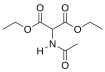
Malonic ester synthesis. In this reaction, diethyl malonate is used to turn an alkyl halide into a substituted acetic acid. Note that the reaction ends up extending the carbon chain by two carbons. Despite its name, it does not produce esters.
alkyl halidecarboxylic acid
estercarboxylic acid
lecture 12
C−C forming
p. 743
1) EAA, NaOEt, EtOH
2) H3O+, Δ
Acetoacetic ester synthesis. This reaction uses ethyl acetoacetate to extend a carbon chain by three carbon atoms.
alkyl halideketone
esterketone
lecture 12
C−C forming
p. 760
R''=O
Na+-OEt, EtOH
Aldol condensation. The acceptor compound needs to lack α-hydrogens next to its carbonyl group for this reaction. The two α-hydrogens from the donor compound form H2O with the acceptor compound oxygen, leading to a dehydration.
ketonealkene
aldehydealkene
lecture 13
C−C forming
p. 764
1) Na+-OEt, EtOH
2) H3O+, Δ
Claisen condensation. This reaction forms a β‑keto ester from two esters. RO- ends up being the leaving group.
esterβ‑keto ester
ester1° alcohol
lecture 13
name reaction
C−C forming
p. 770
R''−CH=CH−COH
H3O+
Michael addition reaction. This reaction requires a very stable enolate ion (e.g. from a β‑keto ester) and an unhindered α,β‑unsaturated aldehyde or ketone.
β‑keto esteraldehyde
aldehydeβ‑keto ester
lecture 13
name reaction
C−C forming
p. 773
R''2NH
Stork reaction. This reaction requires the presence of a hydrogen atom on the α carbon.
ketoneenamine
2° amineenamine
lecture 13
name reaction
p. 776
CH3−COCH=CH2
Na+-OEt, EtOH
Robinson annulation. Combines a Michael reaction with an aldol reaction to form cyclic compounds. The reaction is shown here using 3-buten-2-one, but other α,β‑unsaturated ketone acceptors can be used as well.
β‑keto esterester
β‑keto esterketone
lecture 13
name reaction
C−C forming
p. 879
1) Br2, PBr3
2) H2O; 3) NH3
Hell-Volhard-Zelinsky amination. One way to create amino acids is to combine the previously learned Hell-Volhard-Zelinsky halogenation with an additional nitration step. However, this leads to a racemic mixture of products, which is no good since proteins are made up exclusively of ʟ-amino acids in eukaryotes.
carboxylic acidamino acid
lecture 14
name reaction
p. 880
1) Na+-OEt, EtOH
2) RX; 3) H3O+, Δ
Amidomalonate synthesis. This is a modified version of the malonic ester synthesis, where the R part of the alkyl halide becomes the side chain of the amino acid. A racemic mixture of products is obtained.
esteramino acid
alkyl halideamino acid
lecture 14
C−C forming
C−C cleavage
p. 880
1) NH3
2) NaBH4, EtOH
Reductive amination of α-keto acids. This reaction was also discussed during Lecture 9 and is here applied to help create amino acids. A racemic mixture of products is obtained.
ketoneamino acid
lecture 14
1) NH3
2) HCN; 3) H3O+
Strecker synthesis. This way of forming amino acids uses an aldehyde, ammonia, and cyanide. A racemic mixture of products is obtained.
aldehydeamino acid
lecture 14
name reaction
C−C forming
p. 880
1) H2, Rh catalyst
2) NaOH, H2O
Chiral hydrogenation. Also known as asymmetric hydrogenation. This reaction is enantioselective owing to the chirality of the reagent.
enamineamino acid
lecture 14
p. 975
R−OH
Retro-Claisen condensation. This reverse Claisen condensation reaction is used to cleave the fatty acid chain in the final step of β‑oxidation. When carried out by biological organisms, CoA−SH is used instead of an alcohol.
β‑keto esterester
1° alcoholester
lecture 15
name reaction
C−C cleavage
Made by Alex Janum and last updated on . The material on this page is available under a Creative Commons Attribution 4.0 license.